
AI Narration on Audiobook Platforms: The 2026 Rules
ACX bans it, Spotify labels it, Kobo wants it in the metadata. What every major audiobook platform requires when the narration is AI-generated.
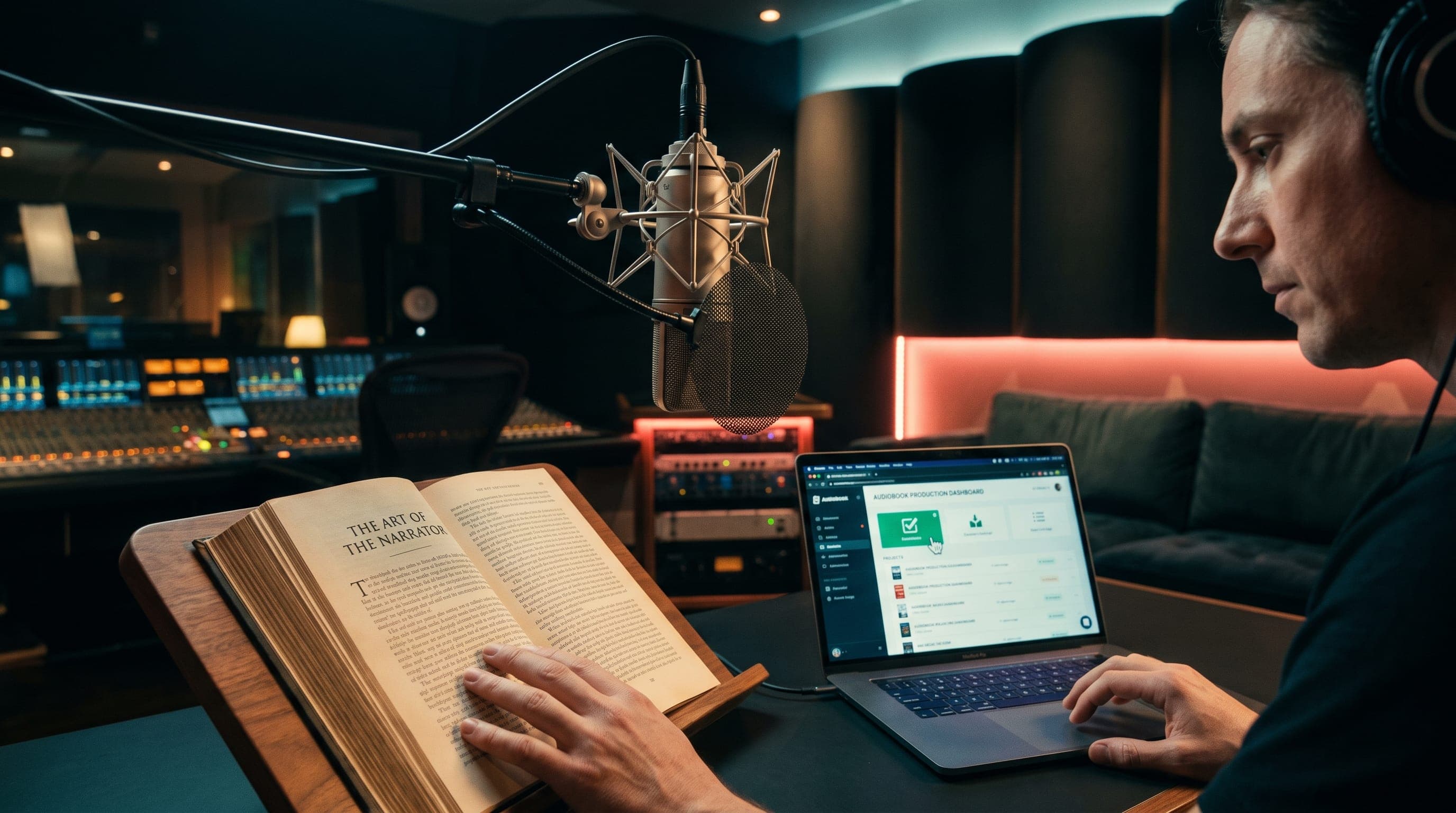
Audible will not take an AI-narrated file through ACX. Spotify will, and prints a disclosure in your book description. Kobo will, as long as you name the narrator as a synthesised voice. There is no single rule for AI narration in audiobooks. There are seven or eight of them, and they do not agree.
This page collects what each major audiobook platform actually requires, and links to the policy page each rule lives on. Everything below comes from the platform’ own documentation rather than from a summary of it.
The rules at a glance
- ACX (Audible) — human narration required; unauthorised text-to-speech is prohibited
- Amazon KDP Virtual Voice — Amazon’ own synthetic narration, in beta, labelled in the store
- Audible for publishers — AI narration and AI translation offered directly to selected publishers
- Spotify for Authors — accepted; you tick a box and Spotify adds a sentence to the description
- Kobo Writing Life — accepted; the narrator credit must read as a synthesised voice
- Google Play Books — Google generates the narration itself from your EPUB
- Apple Books — Apple produces the narration itself from your ebook file
- tolino media (Germany) — accepted, with an explicit labelling duty on the publisher
The pattern gets easier to see once you sort the platforms into two groups. Some let you bring your own AI audio and then ask you to declare it. Others generate the audio themselves, which means the label is theirs to apply and not yours to forget.
Audible and ACX: human narration, with exceptions
ACX is the strictest of the group and says so plainly. Its audio submission requirements, last updated on 15 April 2026, state that a submitted audiobook must be narrated by a human unless otherwise authorised, and that unauthorised use of text-to-speech, AI or automated recordings in ACX titles is prohibited. The same page tells rights holders not to pay a producer they suspect of using text-to-speech.
Read the next sentence on that page and the direction of travel is obvious. Audible states that it is working to accept third-party TTS content from publishers and creators who are interested. The ban is a current position, not a permanent one.
Two carve-outs already exist inside Amazon’ own walls.
Virtual Voice
Kindle Direct Publishing runs audiobooks with virtual voice, a beta launched in the US marketplace that turns an eligible KDP ebook into computer-generated narration. Authors pick from 80 voices across American English, British English, Australian English, Latin American and Castilian Spanish, French and Italian, and can set a different voice per chapter. List prices run from $3.99 to $14.99, the royalty is 40 per cent on a la carte sales, and KDP states that titles created this way are clearly labelled in the store.
The reason Amazon is pushing on this is in the first line of that help page: only five per cent of all books on Amazon are released as audiobooks. The gap, not the technology, is the business case.
Narrator voice replicas
In April 2025 Audible said ACX had invited a small group of US narrators into a beta that lets them create and monetise replicas of their own voices. Narrators keep control of which projects they audition for, with the replica or with a live performance, and stay part of the production process. Consent, credit and per-project opt-in — the arrangement voice actors’ organisations have been asking for — are built into it.
AI narration for publishers
On 13 May 2025 Audible announced AI narration for selected publishing partners, either as an end-to-end managed service or self-service, with more than 100 AI voices across English, Spanish, French and Italian. AI translation followed in beta, including a speech-to-speech path that carries the original narrator’ voice and style into another language, with English to Spanish, French, Italian and German first. Publishers can add human linguists for review.
That last detail is the one worth sitting with. A speech-to-speech pipeline turns one narrator’ recorded performance into the raw material for every other language edition. Whether your contract permits that is a question about your paperwork, not about the technology.
Spotify: accepted, and disclosed in the description
Spotify is the clearest of the big platforms. Its digital voice narration help page says outright that Spotify accepts audiobooks with digital voice narration, that you select the option marked “This audiobook uses digital voice narration” at upload, and that Spotify then adds a short sentence to the book description so listeners know.
The exact wording appears in ElevenLabs’ February 2025 announcement of its Spotify distribution route: the sentence “This audiobook is narrated by a digital voice.” is prepended to the first sentence of the audiobook description. Spotify names Google Play Books and ElevenLabs among accepted providers.
Two practical notes. Spotify does not currently pass digital-voice titles to its referral partners, so distribution is narrower than for a human read. And the flag is reversible: replace the AI narration with a human recording, untick the box, and Spotify removes the disclosure sentence.
Kobo, Google and Apple: the metadata route
Kobo Writing Life takes the most relaxed line. Its AI narration help article, updated on 23 July 2026, says Rakuten Kobo gladly accepts AI narration and asks for at least two contributors, one author and one narrator. If the narration is synthetic, the narrator contributor must be listed as a synthesised voice, male, female or unspecified. No exclusivity, no separate approval.
Google Play Books works differently: under its auto-narrated audiobooks programme, Google generates the narration from your EPUB rather than accepting a file you produced elsewhere. The programme policies cover rights and pricing — you must own the audiobook rights, there is no programme fee during the beta, and if you download and sell the file elsewhere, the Play list price must not be higher than the price on other retail platforms. The listener-facing signal comes from the store and from downstream retailers such as Spotify, not from a disclosure field you fill in.
Apple Books takes the same in-house approach. Digital narration is free, produced by Apple from your ebook file by a combination of speech synthesis and Apple’ own linguists, quality control specialists and audio engineers, and delivered through partners including Draft2Digital, Ingram CoreSource and PublishDrive. The publisher keeps audiobook rights and stays free to produce a human-narrated version as well. Apple states plainly that it remains committed to human narration alongside this.
Germany: tolino media puts the duty on you
Germany’ main self-publishing route for audiobooks is tolino media, and its audiobook FAQ answers the question directly. Yes, you may publish an audiobook made with an AI tool and an AI voice. But you are obliged to label the AI content and the AI narrators, and tolino warns that some distribution channels, Audible among them, do not list audiobooks with an AI voice.
The technical specs differ from ACX in ways that catch people out. tolino asks for MP3 at 44.1 kHz, stereo, RMS between −24 dB and −14 dB, a maximum of 60 minutes per track and pauses no longer than five seconds. ACX wants 192 kbps constant bit rate MP3 at 44.1 kHz, RMS between −23 dB and −18 dB, peaks below −3 dB, a noise floor below −60 dB RMS and no file longer than 120 minutes. Neither is a loudness target in the broadcast sense — see our guide to LUFS targets by platform for how audiobook RMS relates to the rest of the audio world.
The AI Act sits on top of all of this
Ticking a platform box is not the same thing as complying with the law. Since 2 August 2026, Article 50 of the EU AI Act has applied to synthetic and manipulated audio published in the EU, and it creates duties that no store checkbox discharges for you — machine-readable marking of generated output, and disclosure to the audience where the audio resembles a real person. We cover the split between providers and deployers in our explainer on Article 50 and synthetic voice.
The practical consequence for publishers is that platform policy and legal obligation now run on separate tracks. Kobo asks for a metadata field. The AI Act asks for a marked file and a disclosure the listener actually encounters. Doing the first does not automatically satisfy the second.
What this means if you narrate for a living
Read each platform for which of three things it does: ban AI narration, label it, or generate it. The bans are the least stable category — ACX’ own page already signals movement. The labels are the most useful, because a visible disclosure keeps human narration a distinguishable product rather than an invisible premium.
Three things worth checking before you sign anything:
- Training rights. Does the agreement let the counterparty use your recordings to build or improve a voice model? Separate that from the licence to distribute the finished audiobook.
- Translation rights. Speech-to-speech translation reuses your performance, not just your text. If foreign-language editions are not addressed, they are not granted — and they are not paid.
- Credit. If a replica of your voice narrates a title, insist the credit says so. Attribution is what keeps the market able to tell the two apart.
What you get paid for licensing a voice, as opposed to performing, is a separate question with published numbers behind it. We collected them in AI voice licensing rates, and the underlying legal position varies by country — see who owns your voice.
When the book needs a human read
Synthetic narration has found its market: backlist, reference, non-fiction with little dialogue, titles that would never have supported a full production budget. It has not solved character work, comic timing or a narrator who understands why a sentence turns.
If your title is in the second group, the shortest route is a native-language performer who delivers broadcast-ready audio. Voicfy takes a project brief and returns quotes from vetted native-language voice talent, usually inside 48 hours. Start with the hiring page if you want to compare voices before you commit.
Related Articles
AI Voice Disclosure Rules: A Platform-by-Platform Guide
Where you must label an AI voice in 2026: the YouTube, TikTok, Meta, Audible and Spotify rules, checked against the EU AI Act baseline and its code.
AI Voice Training Opt-Out: What the Law Now Requires
AI training on your voice is allowed in the EU unless you opt out — machine-readably. What § 44b, the LAION rulings and the AI Act actually require.

EU AI Act Article 50: What Voice Work Must Disclose
Article 50 of the EU AI Act has applied since 2 August 2026. What synthetic voice must disclose, who carries the duty, and what marking counts.

Netflix and German Dubbing: The AI Consent Dispute
German voice actors have refused Netflix work since February 2026 over an AI training clause. What the contract says and where the dispute stands.

Is Audio Description Legally Required? EU and UK Rules
No single EU law makes audio description mandatory. What the Accessibility Act, the AVMSD, WCAG and Ofcom each actually require, with sources.
Voicfy
Ready to hire a voice actor?
Post a brief, receive quotes from curated native talent, and get broadcast-ready audio within 48 hours.
Post a Project