
AI Voice Training Opt-Out: What the Law Now Requires
AI training on your voice is allowed in the EU unless you opt out — machine-readably. What § 44b, the LAION rulings and the AI Act actually require.
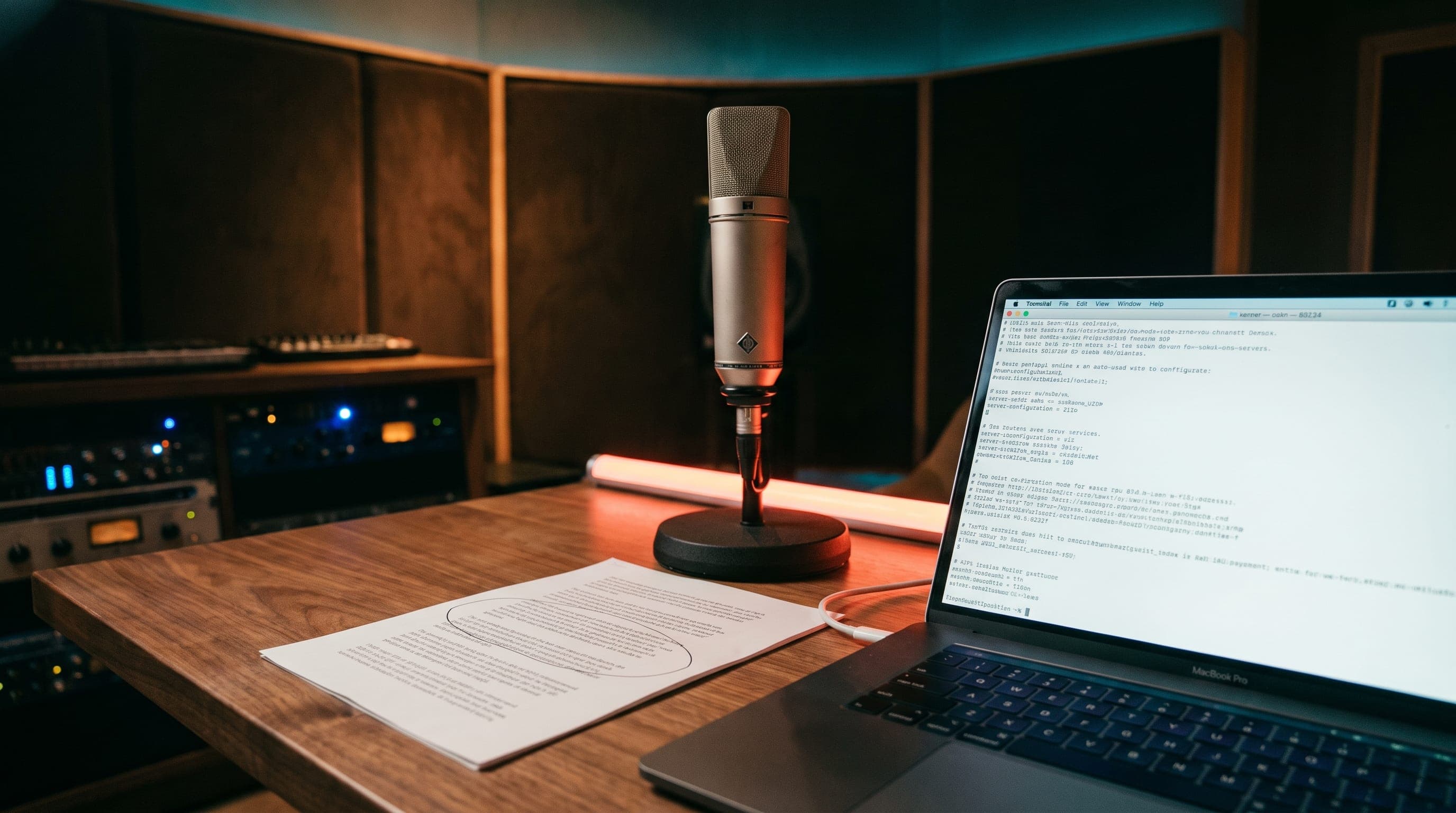
Under EU copyright law, an AI developer may copy lawfully accessible material to build training data unless the rights holder has reserved that use — and for anything published online, the reservation only counts if it is machine-readable. For anyone who records voice for a living, that turns an ethical question into a technical one. Your demo reel is available for text and data mining until you say otherwise, in a form a crawler can actually read.
Germany has now tested that rule twice in court, both times against the rights holder, and the Federal Court of Justice hears the case on 3 September 2026. This page sets out what the statute requires, what the rulings have found so far, what a valid reservation looks like in practice, and where the mechanism stops working for voice work altogether. Every source is dated. The case law is not final.
The exception you have to opt out of
Article 4 of the Digital Single Market Directive (EU) 2019/790 allows reproductions and extractions of lawfully accessible works for text and data mining, for any purpose including commercial ones. The permission applies on one condition: the use has not been expressly reserved by the rights holder in an appropriate manner. For content made publicly available online, the Directive says that reservation must be made by machine-readable means. Article 3 is the separate research exception for research organisations and heritage institutions, and it cannot be switched off by a reservation at all.
Germany implemented Article 4 as § 44b UrhG. Subsection 2 permits the copies needed for mining and requires their deletion once they are no longer needed. Subsection 3 makes the use conditional on no reservation having been declared, and states that a reservation for works available online is only effective in machine-readable form.
Voice actors do not usually hold copyright in a script, so it matters that the regime reaches performances as well. § 83 UrhG applies the limitation provisions of §§ 44a to 63a to the performer rights in §§ 77 and 78. A recorded performance therefore sits inside the same mining exception — and inside the same opt-out.
None of this is worldwide. In the United States there is no opt-out register and no equivalent condition; training claims are argued case by case, largely on fair use. A reservation declared in Europe is a European instrument, which is why the AI Act provision discussed below matters so much.
What the German courts have decided so far
The reference case is Kneschke v LAION e.V., brought by a stock photographer over a single image used while assembling the LAION 5B dataset. The Hamburg Regional Court dismissed the claim on 27 September 2024 (case 310 O 227/23), holding that downloading images to check whether they matched their captions was text and data mining, and that the non-profit could rely on the research exception in § 60d UrhG.
The Hanseatic Higher Regional Court dismissed the appeal on 10 December 2025 (case 5 U 104/24). Three findings from that judgment are the ones being quoted:
- Building a training dataset falls under § 44b. The court rejected the argument that the provision does not cover generative AI, reasoning that the legislature had AI applications in mind when it was drafted.
- The rights holder carries the burden of proving that a reservation was machine-readable at the moment the content was used.
- A reservation written in natural language in a site's terms of use did not meet that standard in this case. In the court's reasoning, a reservation is machine-readable only if it can be automatically captured, interpreted and complied with — not merely found.
Leave to appeal was granted because of the case's fundamental importance. The proceedings run at the Federal Court of Justice as I ZR 281/25, with the public hearing set for 3 September 2026 in Karlsruhe. The court may also refer questions of interpretation to the Court of Justice of the European Union, since the German provisions implement EU law.
Two caveats belong on any citation of this line of cases. It concerns a photograph, not a voice recording, and the appellate reasoning is contested — rights holder organisations including Initiative Urheberrecht read the ruling as evidence that the opt-out mechanism does not work in practice and have called for legislative change. Nothing here is settled until the Federal Court of Justice rules.
What machine-readable looks like in practice
There is no binding technical standard. The closest thing to one is the TDM Reservation Protocol, published as a W3C Community Group Final Report on 10 May 2024 and written specifically as a technical answer to Article 4. It defines one boolean property, tdm-reservation, where the value 1 means rights are reserved, and an optional tdm-policy property pointing at a licensing policy.
The protocol offers four carriers, and the specification asks you to pick one rather than scatter them:
- A file named tdmrep.json in the /.well-known directory of your web server, listing path patterns and their reservation value. This is the site-wide route and the first thing a compliant agent checks.
- An HTTP response header on every file served, in the form tdm-reservation: 1. The specification calls this the preferred technique because it travels with the audio file itself, not just the page around it.
- A meta element in the HTML of a page, with the name tdm-reservation and the content 1.
- Embedded metadata inside EPUB and PDF files. There is no equivalent clause for audio containers in the specification, which is a real gap for voice work: an MP3 lifted off your site carries no reservation with it.
A robots.txt directive is a different instrument. It tells named crawlers where they may go; it does not by itself express a reservation of rights under § 44b. Publishing both is sensible, and several German practitioners recommend exactly that, but the robots file alone is not what the statute asks for.
Because the burden of proof sits with you, treat the reservation as evidence and not just as configuration. Keep dated archive copies of the header response, the well-known file and the page source from the moment you published them. The plaintiff in the LAION case lost the opt-out point partly on the question of what could be demonstrated about the state of the site at the relevant time.
There is also a collective route. GEMA declared a text and data mining reservation for the works of its members and published it on 17 April 2024, and it requires broadcasters and online services that licence the repertoire to carry that reservation onward in machine-readable form when they make works available. Performers in Germany are represented for their related rights by the GVL. Before assuming you are covered by a society-wide declaration, check what your society has actually declared, and for which rights.
Where the opt-out cannot reach
The reservation has to sit where the content is published. That is the practical limit of the whole mechanism for voice work, because most of your recorded output lives on servers you do not control: an agency roster, a client's video channel, a streamer's dubbing master, a podcast feed, an e-learning platform. You can configure your own site perfectly and still have twenty years of work published elsewhere without a signal attached.
Which is why the working instrument is the contract, not the server. Ask hosts and agencies in writing to carry a reservation on the pages where your audio sits, and put the AI question directly into the engagement terms. The SAG-AFTRA Interactive Media Agreement, ratified in 2025, is the most detailed public model: it treats a voice actor as a human performer, requires informed written consent for the creation and use of a digital voice replica, sets collectively bargained minimums for replica use, and lets performers suspend consent for new generated material during a strike. The German dubbing sector has been arguing the same question in public since early 2026, which we track in our piece on the Netflix consent dispute.
Note also that offline material is treated differently. The machine-readable requirement in § 44b(3) attaches to works made available online. For recordings that were never published online, a reservation declared in plain written form can be enough — which makes written delivery terms worth more than they look.
Finally, copyright is only one of the two layers. A reservation under § 44b governs the copying of the recording. It says nothing about the personality right in the voice itself, which is a separate claim in German law and which the mining exception does not touch. We set out that second layer, and how it differs across countries, in who owns your voice.
What the AI Act adds to the reservation
Article 53(1)(c) of the AI Act requires providers of general-purpose AI models to put in place a policy to comply with Union copyright law, and in particular to identify and respect reservations of rights expressed under Article 4 of the Directive. The point of that clause is reach: it is addressed at the model provider, including providers placing models on the EU market from outside it, rather than only at whoever ran the crawler.
Article 53(1)(d) requires a sufficiently detailed public summary of the content used for training, following a template from the AI Office. The Commission published the Explanatory Notice and Template on 24 July 2025. The obligation applies from 2 August 2025 for new models, while models placed on the market before that date must publish their summary by 2 August 2027. Those summaries are the first documents in which a performer can plausibly go looking for the source of their own recordings.
Article 50, the transparency duty that makes synthetic audio disclosable, is a separate obligation that has applied since 2 August 2026. It is often conflated with the training question and answers none of it. We cover it in Article 50 and synthetic voice, and the platform-level labelling rules in AI voice disclosure rules.
A working checklist
None of these steps is expensive. Together they turn an intention into something you could put in front of a court.
- Serve the tdm-reservation header with value 1 for the audio and page paths on your own domain, and publish a tdmrep.json file in /.well-known covering the whole site.
- Add the tdm-reservation meta element to demo and portfolio pages, and keep a robots.txt alongside it for the named AI crawlers.
- Archive dated evidence — response headers, page source, the well-known file — every time you change the configuration.
- Ask agencies, casting platforms and clients in writing to carry the same reservation where they host your audio, and record their answer.
- Make AI training a separate, separately signed consent in every engagement, with its own fee. Silence in a contract is not a reservation.
- Check what your collecting society has declared for the rights you hold, and read the training-data summaries as they are published.
For clients, the same facts run in the other direction. If you commission voice work, the cleanest position is a written consent that says whether training is permitted, at what price, and for how long — not an assumption that silence is permission. That is how we structure briefs on Voicfy, where every project is recorded by a named native speaker who agrees the terms before the session, and it is the part of the paperwork that becomes hardest to fix after delivery.
Sources were checked on 25 August 2026. The German case law described here is pending before the Federal Court of Justice and may change.
Related Articles
AI Narration on Audiobook Platforms: The 2026 Rules
ACX bans it, Spotify labels it, Kobo wants it in the metadata. What every major audiobook platform requires when the narration is AI-generated.

AI Voice Disclosure Rules: A Platform-by-Platform Guide
Where you must label an AI voice in 2026: the YouTube, TikTok, Meta, Audible and Spotify rules, checked against the EU AI Act baseline and its code.

EU AI Act Article 50: What Voice Work Must Disclose
Article 50 of the EU AI Act has applied since 2 August 2026. What synthetic voice must disclose, who carries the duty, and what marking counts.

Netflix and German Dubbing: The AI Consent Dispute
German voice actors have refused Netflix work since February 2026 over an AI training clause. What the contract says and where the dispute stands.

Is Audio Description Legally Required? EU and UK Rules
No single EU law makes audio description mandatory. What the Accessibility Act, the AVMSD, WCAG and Ofcom each actually require, with sources.
Voicfy
Ready to hire a voice actor?
Post a brief, receive quotes from curated native talent, and get broadcast-ready audio within 48 hours.
Post a Project